

07、MDIO总线介绍及注册
mdio bus是mdio管里phy寄存器的总线,此总线非设备驱动模型之总线。mdiobus在内核中用mii_bus结构体描述,mii_bus定义如下:
📢今天介绍以太网的mii_bus结构的stmmac_mdio_register注册函数解析
phy id 是移植过程中,最为关注的内容。
一、mii_bus
目录:linux/phy.h
/*
 * The Bus class for PHYs.  Devices which provide access to
 * PHYs should register using this structure
 */
struct mii_bus {
        struct module *owner;
        const char *name;
        char id[MII_BUS_ID_SIZE];
        void *priv;
        int (*read)(struct mii_bus *bus, int addr, int regnum);
        int (*write)(struct mii_bus *bus, int addr, int regnum, u16 val);
        int (*reset)(struct mii_bus *bus);

        /*
         * A lock to ensure that only one thing can read/write
         * the MDIO bus at a time
         */
        struct mutex mdio_lock;

        struct device *parent;
        enum {
                MDIOBUS_ALLOCATED = 1,
                MDIOBUS_REGISTERED,
                MDIOBUS_UNREGISTERED,
                MDIOBUS_RELEASED,
        } state;
        struct device dev;

        /* list of all PHYs on bus */
        struct mdio_device *mdio_map[PHY_MAX_ADDR];

        /* PHY addresses to be ignored when probing */
        u32 phy_mask;

        /* PHY addresses to ignore the TA/read failure */
        u32 phy_ignore_ta_mask;

        /*
         * An array of interrupts, each PHY's interrupt at the index
         * matching its address
         */
        int irq[PHY_MAX_ADDR];

        /* GPIO reset pulse width in microseconds */
        int reset_delay_us;
        /* RESET GPIO descriptor pointer */
        struct gpio_desc *reset_gpiod;
};mdiobus代码在内核源码树中的位置为:drivers/net/phy/mdio_bus.c。

跟mdiobus_register
二、mii_bus的注册
MAC控制器来完成MDIO总线的注册
使用者stmmac_mdio.c --- stmmac_dvr_probe
定义位置:stmmac_mdio.c
/**
 * stmmac_mdio_register
 * @ndev: net device structure
 * Description: it registers the MII bus
 */
int stmmac_mdio_register(struct net_device *ndev)
{
        int err = 0;
        struct mii_bus *new_bus;
        struct stmmac_priv *priv = netdev_priv(ndev);
        struct stmmac_mdio_bus_data *mdio_bus_data = priv->plat->mdio_bus_data;
        struct device_node *mdio_node = priv->plat->mdio_node;
        int addr, found;

        if (!mdio_bus_data)
                return 0;

        new_bus = mdiobus_alloc();
        if (!new_bus)
                return -ENOMEM;

        if (mdio_bus_data->irqs)
                memcpy(new_bus->irq, mdio_bus_data->irqs, sizeof(new_bus->irq));

#ifdef CONFIG_OF
        if (priv->device->of_node)
                mdio_bus_data->reset_gpio = -1;
#endif

        new_bus->name = "stmmac";
        new_bus->read = &stmmac_mdio_read;
        new_bus->write = &stmmac_mdio_write;

        new_bus->reset = &stmmac_mdio_reset;
        snprintf(new_bus->id, MII_BUS_ID_SIZE, "%s-%x",
                 new_bus->name, priv->plat->bus_id);
        new_bus->priv = ndev;
        new_bus->phy_mask = mdio_bus_data->phy_mask;
        new_bus->parent = priv->device;

        if (mdio_node)
                err = of_mdiobus_register(new_bus, mdio_node);
        else
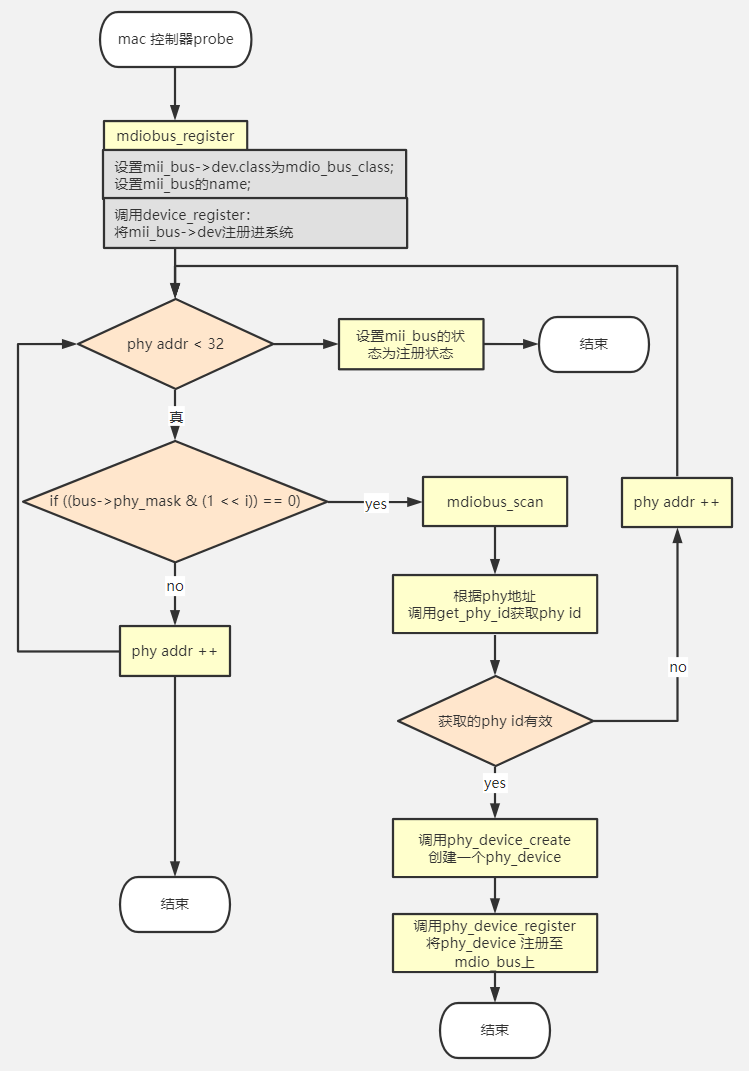
err = mdiobus_register(new_bus);该接口主要用于向系统中注册一个mii_bus device,并将该device注册至mdio_bus_class。
调用
device_register,将该mii_bus的device成员注册至系统的device_kset中,并完成与mdio_bus_class的关联;针对
phy address范围为[0-31],且mii_bus未设置忽略该phyid检测,则调用mdio_scan去搜索该phy addr下是否挂载了phy device(通过mii_bus->read接口,获取phy id),若获取到phy_id,则调用phy_device_register,将扫描到的phy_device注册至mdio_bus_type中。
目录:drivers\net\phy\mdio_bus.c
#define mdiobus_register(bus) __mdiobus_register(bus, THIS_MODULE)
/**
 * __mdiobus_register - bring up all the PHYs on a given bus and attach them to bus
 * @bus: target mii_bus
 * @owner: module containing bus accessor functions
 *
 * Description: Called by a bus driver to bring up all the PHYs
 *   on a given bus, and attach them to the bus. Drivers should use
 *   mdiobus_register() rather than __mdiobus_register() unless they
 *   need to pass a specific owner module. MDIO devices which are not
 *   PHYs will not be brought up by this function. They are expected to
 *   to be explicitly listed in DT and instantiated by of_mdiobus_register().
 *
 * Returns 0 on success or < 0 on error.
 */
int __mdiobus_register(struct mii_bus *bus, struct module *owner)
{
        struct mdio_device *mdiodev;
        int i, err;
        struct gpio_desc *gpiod;

        if (NULL == bus || NULL == bus->name ||
            NULL == bus->read || NULL == bus->write)
                return -EINVAL;

        BUG_ON(bus->state != MDIOBUS_ALLOCATED &&
               bus->state != MDIOBUS_UNREGISTERED);

        bus->owner = owner;
        bus->dev.parent = bus->parent;
        bus->dev.class = &mdio_bus_class;
        bus->dev.groups = NULL;
        dev_set_name(&bus->dev, "%s", bus->id);

        err = device_register(&bus->dev);
        if (err) {
                pr_err("mii_bus %s failed to register\n", bus->id);
                put_device(&bus->dev);
                return -EINVAL;
        }

        mutex_init(&bus->mdio_lock);

        /* de-assert bus level PHY GPIO resets */
        if (bus->num_reset_gpios > 0) {
                bus->reset_gpiod = devm_kcalloc(&bus->dev,
                                                 bus->num_reset_gpios,
                                                 sizeof(struct gpio_desc *),
                                                 GFP_KERNEL);
                if (!bus->reset_gpiod)
                        return -ENOMEM;
        }

        for (i = 0; i < bus->num_reset_gpios; i++) {
                gpiod = devm_gpiod_get_index(&bus->dev, "reset", i,
                                             GPIOD_OUT_LOW);
                if (IS_ERR(gpiod)) {
                        err = PTR_ERR(gpiod);
                        if (err != -ENOENT) {
                                dev_err(&bus->dev,
                                        "mii_bus %s couldn't get reset GPIO\n",
                                        bus->id);
                                return err;
                        }
                } else {
                        bus->reset_gpiod[i] = gpiod;
                        gpiod_set_value_cansleep(gpiod, 1);
                        udelay(bus->reset_delay_us);
                        gpiod_set_value_cansleep(gpiod, 0);
                }
        }

        if (bus->reset)
                bus->reset(bus);

        //#define PHY_MAX_ADDR        32
        for (i = 0; i < PHY_MAX_ADDR; i++) {
                if ((bus->phy_mask & (1 << i)) == 0) {
                        struct phy_device *phydev;

                        phydev = mdiobus_scan(bus, i);
                        if (IS_ERR(phydev) && (PTR_ERR(phydev) != -ENODEV)) {
                                err = PTR_ERR(phydev);
                                goto error;
                        }
                }
        }

        mdiobus_setup_mdiodev_from_board_info(bus, mdiobus_create_device);

        bus->state = MDIOBUS_REGISTERED;
        pr_info("%s: probed\n", bus->name);
        return 0;

error:
        while (--i >= 0) {
                mdiodev = bus->mdio_map[i];
                if (!mdiodev)
                        continue;

                mdiodev->device_remove(mdiodev);
                mdiodev->device_free(mdiodev);
        }

        /* Put PHYs in RESET to save power */
        for (i = 0; i < bus->num_reset_gpios; i++) {
                if (bus->reset_gpiod[i])
                        gpiod_set_value_cansleep(bus->reset_gpiod[i], 1);
        }

        device_del(&bus->dev);
        return err;
}
EXPORT_SYMBOL(__mdiobus_register);三、PHY ID的扫描
目录:drivers\net\phy\mdio_bus.c
phy/mdio_bus.c
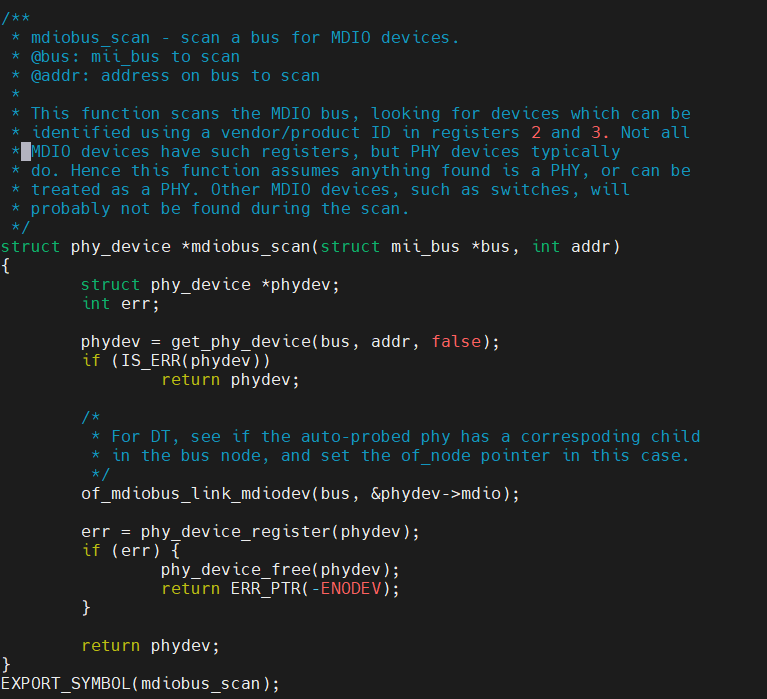
/**
 * mdiobus_scan - scan a bus for MDIO devices.
 * @bus: mii_bus to scan
 * @addr: address on bus to scan
 *
 * This function scans the MDIO bus, looking for devices which can be
 * identified using a vendor/product ID in registers 2 and 3. Not all
 * MDIO devices have such registers, but PHY devices typically
 * do. Hence this function assumes anything found is a PHY, or can be
 * treated as a PHY. Other MDIO devices, such as switches, will
 * probably not be found during the scan.
 */
struct phy_device *mdiobus_scan(struct mii_bus *bus, int addr)
{
        struct phy_device *phydev;
        int err;

        phydev = get_phy_device(bus, addr, false);
        if (IS_ERR(phydev))
                return phydev;

        /*
         * For DT, see if the auto-probed phy has a correspoding child
         * in the bus node, and set the of_node pointer in this case.
         */
        of_mdiobus_link_mdiodev(bus, &phydev->mdio);

        err = phy_device_register(phydev);
        if (err) {
                phy_device_free(phydev);
                return ERR_PTR(-ENODEV);
        }

        return phydev;
}
EXPORT_SYMBOL(mdiobus_scan);3.1、get_phy_device
目录:drivers\net\phy\phy_device.c
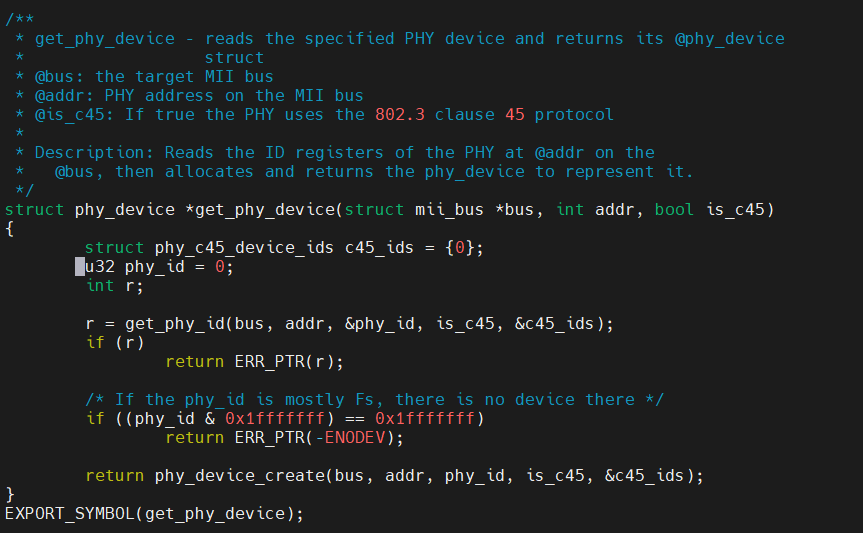
/**
 * get_phy_device - reads the specified PHY device and returns its @phy_device
 *                    struct
 * @bus: the target MII bus
 * @addr: PHY address on the MII bus
 * @is_c45: If true the PHY uses the 802.3 clause 45 protocol
 *
 * Description: Reads the ID registers of the PHY at @addr on the
 *   @bus, then allocates and returns the phy_device to represent it.
 */
struct phy_device *get_phy_device(struct mii_bus *bus, int addr, bool is_c45)
{
        struct phy_c45_device_ids c45_ids = {0};
        u32 phy_id = 0;
        int r;

        r = get_phy_id(bus, addr, &phy_id, is_c45, &c45_ids);
        if (r)
                return ERR_PTR(r);

        /* If the phy_id is mostly Fs, there is no device there */
        if ((phy_id & 0x1fffffff) == 0x1fffffff)
                return ERR_PTR(-ENODEV);

        return phy_device_create(bus, addr, phy_id, is_c45, &c45_ids);
}
EXPORT_SYMBOL(get_phy_device);get_phy_id:
/**
 * get_phy_id - reads the specified addr for its ID.
 * @bus: the target MII bus
 * @addr: PHY address on the MII bus
 * @phy_id: where to store the ID retrieved.
 * @is_c45: If true the PHY uses the 802.3 clause 45 protocol
 * @c45_ids: where to store the c45 ID information.
 *
 * Description: In the case of a 802.3-c22 PHY, reads the ID registers
 *   of the PHY at @addr on the @bus, stores it in @phy_id and returns
 *   zero on success.
 *
 *   In the case of a 802.3-c45 PHY, get_phy_c45_ids() is invoked, and
 *   its return value is in turn returned.
 *
 */
static int get_phy_id(struct mii_bus *bus, int addr, u32 *phy_id,
                      bool is_c45, struct phy_c45_device_ids *c45_ids)
{
        int phy_reg;

        if (is_c45)
                return get_phy_c45_ids(bus, addr, phy_id, c45_ids);

        /* Grab the bits from PHYIR1, and put them in the upper half */
        phy_reg = mdiobus_read(bus, addr, MII_PHYSID1);
        if (phy_reg < 0) {
                /* if there is no device, return without an error so scanning
                 * the bus works properly
                 */
                if (phy_reg == -EIO || phy_reg == -ENODEV) {
                        *phy_id = 0xffffffff;
                        return 0;
                }

                return -EIO;
        }

        *phy_id = (phy_reg & 0xffff) << 16;

        /* Grab the bits from PHYIR2, and put them in the lower half */
        phy_reg = mdiobus_read(bus, addr, MII_PHYSID2);
        if (phy_reg < 0) {
                /* returning -ENODEV doesn't stop bus scanning */
                return (phy_reg == -EIO || phy_reg == -ENODEV) ? -ENODEV : -EIO;
        }

        *phy_id |= (phy_reg & 0xffff);

        return 0;
}如果是C45:
get_phy_c45_ids
static int get_phy_c45_ids(struct mii_bus *bus, int addr, u32 *phy_id,
                           struct phy_c45_device_ids *c45_ids) {
        int phy_reg;
        int i, reg_addr;
        const int num_ids = ARRAY_SIZE(c45_ids->device_ids);
        u32 *devs = &c45_ids->devices_in_package;

        /* Find first non-zero Devices In package. Device zero is reserved
         * for 802.3 c45 complied PHYs, so don't probe it at first.
         */
        for (i = 1; i < num_ids && *devs == 0; i++) {
                phy_reg = get_phy_c45_devs_in_pkg(bus, addr, i, devs);
                if (phy_reg < 0)
                        return -EIO;

                if ((*devs & 0x1fffffff) == 0x1fffffff) {
                        /*  If mostly Fs, there is no device there,
                         *  then let's continue to probe more, as some
                         *  10G PHYs have zero Devices In package,
                         *  e.g. Cortina CS4315/CS4340 PHY.
                         */
                        phy_reg = get_phy_c45_devs_in_pkg(bus, addr, 0, devs);
                        if (phy_reg < 0)
                                return -EIO;
                        /* no device there, let's get out of here */
                        if ((*devs & 0x1fffffff) == 0x1fffffff) {
                                *phy_id = 0xffffffff;
                                return 0;
                        } else {
                                break;
                        }
                }
        }

        /* Now probe Device Identifiers for each device present. */
        for (i = 1; i < num_ids; i++) {
                if (!(c45_ids->devices_in_package & (1 << i)))
                        continue;

                reg_addr = MII_ADDR_C45 | i << 16 | MII_PHYSID1;
                phy_reg = mdiobus_read(bus, addr, reg_addr);
                if (phy_reg < 0)
                        return -EIO;
                c45_ids->device_ids[i] = (phy_reg & 0xffff) << 16;

                reg_addr = MII_ADDR_C45 | i << 16 | MII_PHYSID2;
                phy_reg = mdiobus_read(bus, addr, reg_addr);
                if (phy_reg < 0)
                        return -EIO;
                c45_ids->device_ids[i] |= (phy_reg & 0xffff);
        }
        *phy_id = 0;
        return 0;
}get_phy_id前面咱们分析过,现在重点分析phy_device_create
struct phy_device *phy_device_create(struct mii_bus *bus, int addr, int phy_id,
                                     bool is_c45,
                                     struct phy_c45_device_ids *c45_ids)
{
        struct phy_device *dev;
        struct mdio_device *mdiodev;

        /* We allocate the device, and initialize the default values */
        dev = kzalloc(sizeof(*dev), GFP_KERNEL);
        if (!dev)
                return ERR_PTR(-ENOMEM);

        mdiodev = &dev->mdio;
        mdiodev->dev.release = phy_device_release;
        mdiodev->dev.parent = &bus->dev;
        mdiodev->dev.bus = &mdio_bus_type;
        mdiodev->bus = bus;
        mdiodev->pm_ops = MDIO_BUS_PHY_PM_OPS;
        mdiodev->bus_match = phy_bus_match;
        mdiodev->addr = addr;
        mdiodev->flags = MDIO_DEVICE_FLAG_PHY;
        mdiodev->device_free = phy_mdio_device_free;
        mdiodev->device_remove = phy_mdio_device_remove;

        dev->speed = 0;
        dev->duplex = -1;
        dev->pause = 0;
        dev->asym_pause = 0;
        dev->link = 1;
        dev->interface = PHY_INTERFACE_MODE_GMII;

        dev->autoneg = AUTONEG_ENABLE;

        dev->is_c45 = is_c45;
        dev->phy_id = phy_id;
        if (c45_ids)
                dev->c45_ids = *c45_ids;
        dev->irq = bus->irq[addr];
        dev_set_name(&mdiodev->dev, PHY_ID_FMT, bus->id, addr);

        dev->state = PHY_DOWN;

        mutex_init(&dev->lock);
        INIT_DELAYED_WORK(&dev->state_queue, phy_state_machine);
        INIT_WORK(&dev->phy_queue, phy_change_work);

        /* Request the appropriate module unconditionally; don't
         * bother trying to do so only if it isn't already loaded,
         * because that gets complicated. A hotplug event would have
         * done an unconditional modprobe anyway.
         * We don't do normal hotplug because it won't work for MDIO
         * -- because it relies on the device staying around for long
         * enough for the driver to get loaded. With MDIO, the NIC
         * driver will get bored and give up as soon as it finds that
         * there's no driver _already_ loaded.
         */
        request_module(MDIO_MODULE_PREFIX MDIO_ID_FMT, MDIO_ID_ARGS(phy_id));

        device_initialize(&mdiodev->dev);

        return dev;
}
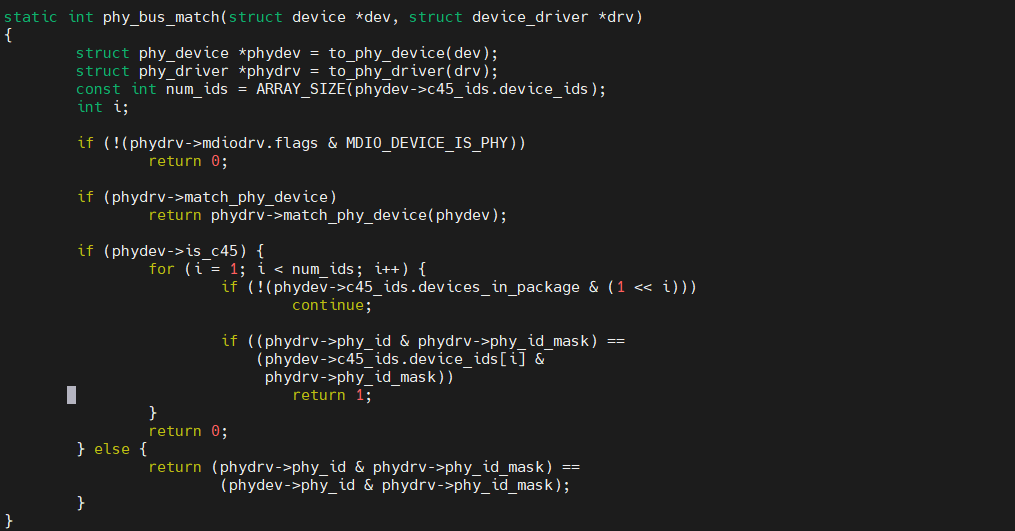
EXPORT_SYMBOL(phy_device_create);其中:phy_bus_match
目录:drivers\base\core.c
/**
 * device_initialize - init device structure.
 * @dev: device.
 *
 * This prepares the device for use by other layers by initializing
 * its fields.
 * It is the first half of device_register(), if called by
 * that function, though it can also be called separately, so one
 * may use @dev's fields. In particular, get_device()/put_device()
 * may be used for reference counting of @dev after calling this
 * function.
 *
 * All fields in @dev must be initialized by the caller to 0, except
 * for those explicitly set to some other value.  The simplest
 * approach is to use kzalloc() to allocate the structure containing
 * @dev.
 *
 * NOTE: Use put_device() to give up your reference instead of freeing
 * @dev directly once you have called this function.
 */
void device_initialize(struct device *dev)
{
        dev->kobj.kset = devices_kset;
        kobject_init(&dev->kobj, &device_ktype);
        INIT_LIST_HEAD(&dev->dma_pools);
        mutex_init(&dev->mutex);
        lockdep_set_novalidate_class(&dev->mutex);
        spin_lock_init(&dev->devres_lock);
        INIT_LIST_HEAD(&dev->devres_head);
        device_pm_init(dev);
        set_dev_node(dev, -1);
#ifdef CONFIG_GENERIC_MSI_IRQ
        INIT_LIST_HEAD(&dev->msi_list);
#endif
        INIT_LIST_HEAD(&dev->links.consumers);
        INIT_LIST_HEAD(&dev->links.suppliers);
        dev->links.status = DL_DEV_NO_DRIVER;
}
EXPORT_SYMBOL_GPL(device_initialize);3.2、phy_device_register
目录:drivers\net\phy\phy_device.c
/**
 * phy_device_register - Register the phy device on the MDIO bus
 * @phydev: phy_device structure to be added to the MDIO bus
 */
int phy_device_register(struct phy_device *phydev)
{
        int err;

        err = mdiobus_register_device(&phydev->mdio);
        if (err)
                return err;

        /* Run all of the fixups for this PHY */
        err = phy_scan_fixups(phydev);
        if (err) {
                pr_err("PHY %d failed to initialize\n", phydev->mdio.addr);
                goto out;
        }

        phydev->mdio.dev.groups = phy_dev_groups;

        err = device_add(&phydev->mdio.dev);
        if (err) {
                pr_err("PHY %d failed to add\n", phydev->mdio.addr);
                goto out;
        }

        return 0;

 out:
        mdiobus_unregister_device(&phydev->mdio);
        return err;
}
EXPORT_SYMBOL(phy_device_register);mdiobus_register_device进行对phydev的管理记录
int mdiobus_register_device(struct mdio_device *mdiodev)
{
        if (mdiodev->bus->mdio_map[mdiodev->addr])
                return -EBUSY;

        mdiodev->bus->mdio_map[mdiodev->addr] = mdiodev;

        return 0;
}
EXPORT_SYMBOL(mdiobus_register_device);实际注册: 目录:drivers\net\phy\phy_device.c
/**
 * device_add - add device to device hierarchy.
 * @dev: device.
 *
 * This is part 2 of device_register(), though may be called
 * separately _iff_ device_initialize() has been called separately.
 *
 * This adds @dev to the kobject hierarchy via kobject_add(), adds it
 * to the global and sibling lists for the device, then
 * adds it to the other relevant subsystems of the driver model.
 *
 * Do not call this routine or device_register() more than once for
 * any device structure.  The driver model core is not designed to work
 * with devices that get unregistered and then spring back to life.
 * (Among other things, it's very hard to guarantee that all references
 * to the previous incarnation of @dev have been dropped.)  Allocate
 * and register a fresh new struct device instead.
 *
 * NOTE: _Never_ directly free @dev after calling this function, even
 * if it returned an error! Always use put_device() to give up your
 * reference instead.
 */
int device_add(struct device *dev)
{
        struct device *parent;
        struct kobject *kobj;
        struct class_interface *class_intf;
        int error = -EINVAL;
        struct kobject *glue_dir = NULL;

        dev = get_device(dev);
        if (!dev)
                goto done;

        if (!dev->p) {
                error = device_private_init(dev);
                if (error)
                        goto done;
        }

        /*
         * for statically allocated devices, which should all be converted
         * some day, we need to initialize the name. We prevent reading back
         * the name, and force the use of dev_name()
         */
        if (dev->init_name) {
                dev_set_name(dev, "%s", dev->init_name);
                dev->init_name = NULL;
        }

        /* subsystems can specify simple device enumeration */
        if (!dev_name(dev) && dev->bus && dev->bus->dev_name)
                dev_set_name(dev, "%s%u", dev->bus->dev_name, dev->id);

        if (!dev_name(dev)) {
                error = -EINVAL;
                goto name_error;
        }

        pr_debug("device: '%s': %s\n", dev_name(dev), __func__);

        parent = get_device(dev->parent);
        kobj = get_device_parent(dev, parent);
        if (kobj)
                dev->kobj.parent = kobj;

        /* use parent numa_node */
        if (parent && (dev_to_node(dev) == NUMA_NO_NODE))
                set_dev_node(dev, dev_to_node(parent));

        /* first, register with generic layer. */
        /* we require the name to be set before, and pass NULL */
        error = kobject_add(&dev->kobj, dev->kobj.parent, NULL);
        if (error) {
                glue_dir = get_glue_dir(dev);
                goto Error;
        }

        /* notify platform of device entry */
        if (platform_notify)
                platform_notify(dev);

        error = device_create_file(dev, &dev_attr_uevent);
        if (error)
                goto attrError;

        error = device_add_class_symlinks(dev);
        if (error)
                goto SymlinkError;
        error = device_add_attrs(dev);
        if (error)
                goto AttrsError;
        error = bus_add_device(dev);
        if (error)
                goto BusError;
        error = dpm_sysfs_add(dev);
        if (error)
                goto DPMError;
        device_pm_add(dev);

        if (MAJOR(dev->devt)) {
                error = device_create_file(dev, &dev_attr_dev);
                if (error)
                        goto DevAttrError;

                error = device_create_sys_dev_entry(dev);
                if (error)
                        goto SysEntryError;

                devtmpfs_create_node(dev);
        }

        /* Notify clients of device addition.  This call must come
         * after dpm_sysfs_add() and before kobject_uevent().
         */
        if (dev->bus)
                blocking_notifier_call_chain(&dev->bus->p->bus_notifier,
                                             BUS_NOTIFY_ADD_DEVICE, dev);

        kobject_uevent(&dev->kobj, KOBJ_ADD);
        bus_probe_device(dev);
        if (parent)
                klist_add_tail(&dev->p->knode_parent,
                               &parent->p->klist_children);

        if (dev->class) {
                mutex_lock(&dev->class->p->mutex);
                /* tie the class to the device */
                klist_add_tail(&dev->knode_class,
                               &dev->class->p->klist_devices);

                /* notify any interfaces that the device is here */
                list_for_each_entry(class_intf,
                                    &dev->class->p->interfaces, node)
                        if (class_intf->add_dev)
                                class_intf->add_dev(dev, class_intf);
                mutex_unlock(&dev->class->p->mutex);
        }
done:
        put_device(dev);
        return error;
 SysEntryError:
        if (MAJOR(dev->devt))
                device_remove_file(dev, &dev_attr_dev);
 DevAttrError:
        device_pm_remove(dev);
        dpm_sysfs_remove(dev);
 DPMError:
        bus_remove_device(dev);
 BusError:
        device_remove_attrs(dev);
 AttrsError:
        device_remove_class_symlinks(dev);
 SymlinkError:
        device_remove_file(dev, &dev_attr_uevent);
 attrError:
        kobject_uevent(&dev->kobj, KOBJ_REMOVE);
        glue_dir = get_glue_dir(dev);
        kobject_del(&dev->kobj);
 Error:
        cleanup_glue_dir(dev, glue_dir);
        put_device(parent);
name_error:
        kfree(dev->p);
        dev->p = NULL;
        goto done;
}
EXPORT_SYMBOL_GPL(device_add);