

一、初始化mdio子系统
mdio子系统继承了linux设备驱动模型,在mdio子系统初始化的过程中向内核设备驱动模型注册了mdio总线,mdio总线用来关联mdio设备和驱动。
mdio子系统的初始化在内核源码drivers/net/phy/phy_device.c中。
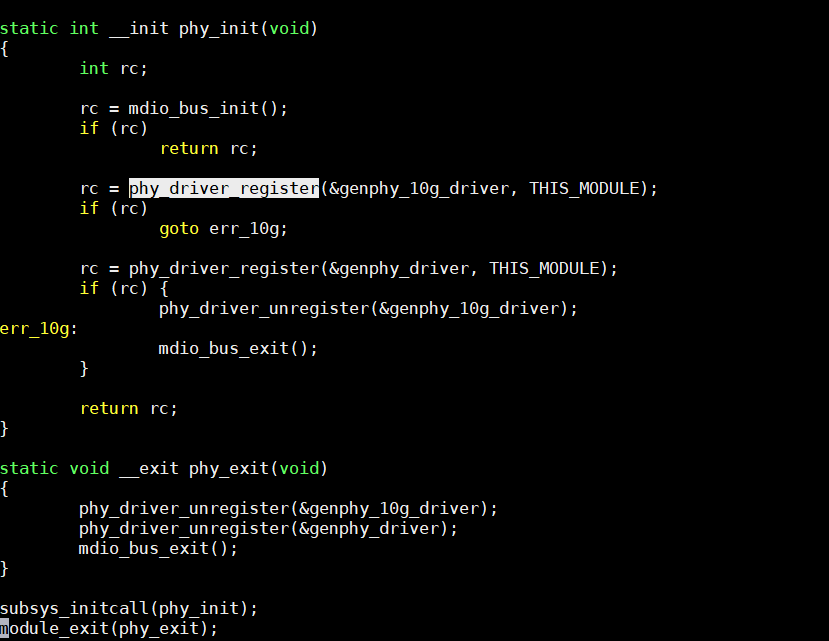
mdio_bus_init:
二、注册phy driver
在mdio子系统初始化的时候通过phy_driver_register接口注册了两个通用的phy驱动。其他phy驱动可以通过module_phy_driver宏注册到mdio子系统核心,以dp83848phy驱动为例,其注册代码如下:
module_phy_driver(realtek_drvs);module_phy_driver宏实现如下:
linux/phy.h
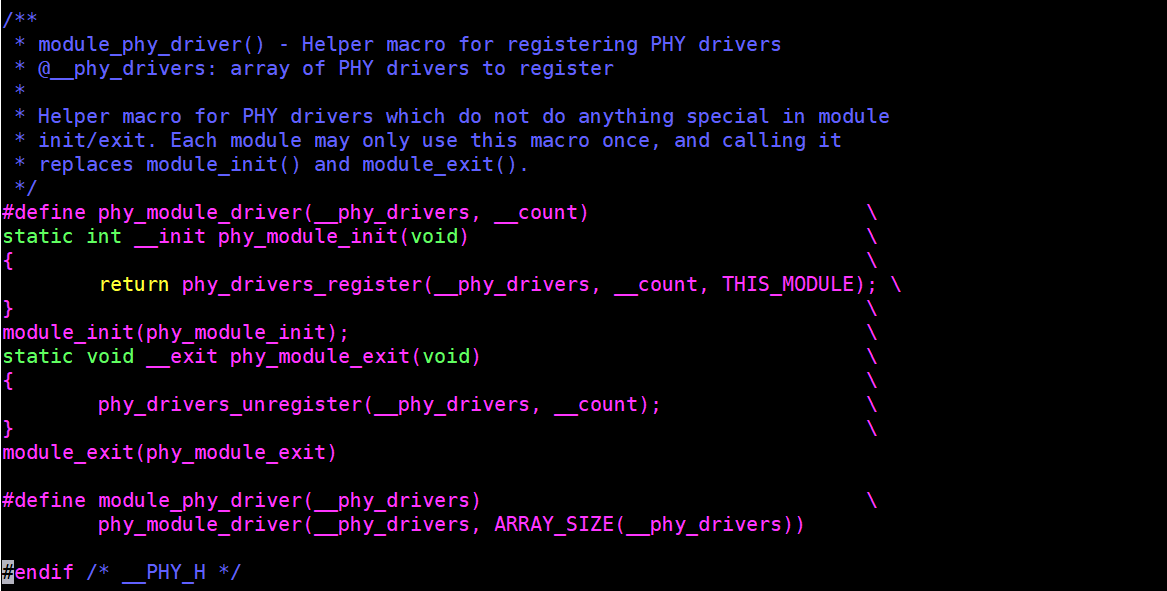
由上面的宏结构可知,其原理是通过module_init定义一个模块初始化函数,在模块初始化函数中调用phy_drivers_register接口注册phy_driver对象。
phy_drivers_register:
三、申请注册mii_bus
一般在网卡驱动的probe初始化网卡驱动的时候申请mii_bus,以stmmac网卡驱动为例,在其probe函数中调用stmmac_mdio_register()函数来初始化mii_bus,在该函数中申请了mii_bus并设置了read和write回调函数。
net/ethernet/stmicro/stmmac/stmmac_mdio.c
int stmmac_mdio_register(struct net_device *ndev)
{
        int err = 0;
        struct mii_bus *new_bus;
        struct stmmac_priv *priv = netdev_priv(ndev);
        struct stmmac_mdio_bus_data *mdio_bus_data = priv->plat->mdio_bus_data;
        struct device_node *mdio_node = priv->plat->mdio_node;
        struct device *dev = ndev->dev.parent;
        int addr, found, max_addr;

        if (!mdio_bus_data)
                return 0;

        new_bus = mdiobus_alloc();
        if (!new_bus)
                return -ENOMEM;

        if (mdio_bus_data->irqs)
                memcpy(new_bus->irq, mdio_bus_data->irqs, sizeof(new_bus->irq));

#ifdef CONFIG_OF
        if (priv->device->of_node)
                mdio_bus_data->reset_gpio = -1;
#endif

        new_bus->name = "stmmac";

        if (priv->plat->has_xgmac) {
                new_bus->read = &stmmac_xgmac2_mdio_read;
                new_bus->write = &stmmac_xgmac2_mdio_write;

                /* Right now only C22 phys are supported */
                max_addr = MII_XGMAC_MAX_C22ADDR + 1;

                /* Check if DT specified an unsupported phy addr */
                if (priv->plat->phy_addr > MII_XGMAC_MAX_C22ADDR)
                        dev_err(dev, "Unsupported phy_addr (max=%d)\n",
                                        MII_XGMAC_MAX_C22ADDR);
        } else {
                new_bus->read = &stmmac_mdio_read;
                new_bus->write = &stmmac_mdio_write;
                max_addr = PHY_MAX_ADDR;
        }

        new_bus->reset = &stmmac_mdio_reset;
        snprintf(new_bus->id, MII_BUS_ID_SIZE, "%s-%x",
                 new_bus->name, priv->plat->bus_id);
        new_bus->priv = ndev;
        new_bus->phy_mask = mdio_bus_data->phy_mask;
        new_bus->parent = priv->device;

        err = of_mdiobus_register(new_bus, mdio_node);
        if (err != 0) {
                dev_err(dev, "Cannot register the MDIO bus\n");
                goto bus_register_fail;
        }

        stmmac_mdio_write(new_bus,0,31,2627);
        stmmac_mdio_write(new_bus,0,25,0x1801);
        stmmac_mdio_write(new_bus,0,31,0);
        stmmac_mdio_write(new_bus,0,0,0x8000);

        if (priv->plat->phy_node || mdio_node)
                goto bus_register_done;

        found = 0;
        for (addr = 0; addr < max_addr; addr++) {
                struct phy_device *phydev = mdiobus_get_phy(new_bus, addr);

                if (!phydev)
                        continue;

                /*
                 * If an IRQ was provided to be assigned after
                 * the bus probe, do it here.
                 */
                if (!mdio_bus_data->irqs &&
                    (mdio_bus_data->probed_phy_irq > 0)) {
                        new_bus->irq[addr] = mdio_bus_data->probed_phy_irq;
                        phydev->irq = mdio_bus_data->probed_phy_irq;
                }

                /*
                 * If we're going to bind the MAC to this PHY bus,
                 * and no PHY number was provided to the MAC,
                 * use the one probed here.
                 */
                if (priv->plat->phy_addr == -1)
                        priv->plat->phy_addr = addr;

                phy_attached_info(phydev);
                found = 1;
        }

        if (!found && !mdio_node) {
                dev_warn(dev, "No PHY found\n");
                mdiobus_unregister(new_bus);
                mdiobus_free(new_bus);
                return -ENODEV;
        }

bus_register_done:
        priv->mii = new_bus;

return 0;stmmac_xgmac2_mdio_read
stmmac_mdio_read
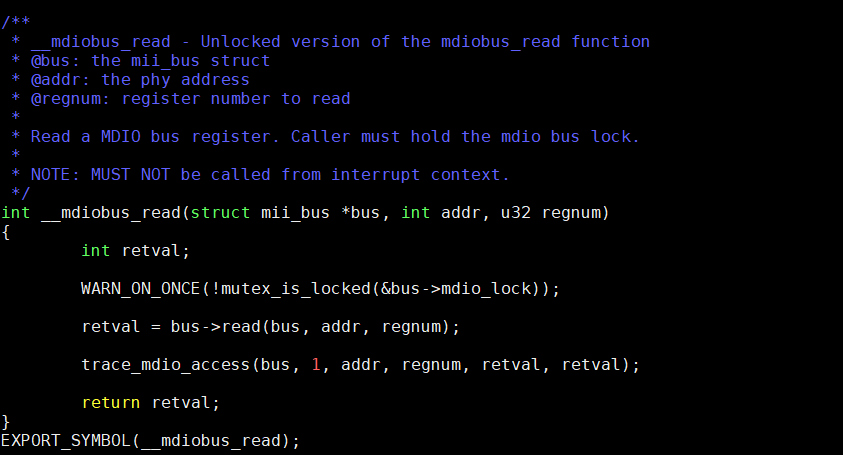
net/phy/mdio_bus.c
四、注册phy设备
一般动态扫描的phy设备在网卡驱动初始化的时候注册,仍然以stmmac网卡驱动为例,在其平台probe初始化中调用stmmac_dvr_probe函数、最终调用stmmac_mdio_register申请mii_bus后,调用mdiobus_register函数创建并注册phy_device对象。
mdiobus_register(new_bus);