

一、什么是自旋锁
自旋锁是一种用来保护共享资源的锁机制。它的特点是:当线程要获取锁时,如果锁正被其他线程占用,该线程不会停下来等待,而是持续用 CPU 反复尝试获取锁。这种不停"转圈等待"的方式,就是"自旋"。
使用场景
在什么情况下用自旋锁呢?比如当共享资源的锁定时间非常短(比如几微秒),这时让线程暂停再恢复的开销反而更大。如果有多个 CPU 核心,等待的线程可以继续占用 CPU 自旋,同时其他核心还能处理其他任务,这样反而更高效。
举个例子:银行 ATM 防护舱同一时间只能一人使用。当有人进去后,防护舱锁上,其他人只能在外面等待。但自旋锁不同,等待的人不会真的排队,而是不停看门是否开了——如果舱内的人两秒内出来开门,等待的人立刻就能进去,省去了排队的时间。
在程序中使用自旋锁时,每个任务获取锁后,其他想要获取锁的任务只能不断循环等待。虽然这种方式会一直占用 CPU,但只要临界区(需要锁保护的代码段)足够短,总效率反而更高。
注意
如果自旋锁用得不对(比如锁住时间太长或多个线程互相等待),可能导致死锁——这种情况会在后面详细讲解。
内核中以 spinlock_t 结构体来表示自旋锁,定义在 内核源码/include/linux/spinlock_types.h 文件中,如下所示:
c
typedef struct spinlock {
    union {
        struct raw_spinlock rlock;

#ifdef CONFIG_DEBUG_LOCK_ALLOC
## define LOCK_PADSIZE (offsetof(struct raw_spinlock, dep_map))
        struct {
            u8 __padding[LOCK_PADSIZE];
            struct lockdep_map dep_map;
        };
#endif
    };
} spinlock_t;二、基础 API 介绍
自旋锁相关 API 函数定义在 内核源码/include/linux/spinlock.h 文件中。
| 函数 | 描述 |
|---|---|
DEFINE_SPINLOCK(spinlock_t lock) | 定义并初始化自旋锁 |
int spin_lock_init(spinlock_t *lock) | 初始化自旋锁 |
void spin_lock(spinlock_t *lock) | 获取指定的自旋锁,也叫做加锁 |
void spin_unlock(spinlock_t *lock) | 释放指定的自旋锁 |
int spin_trylock(spinlock_t *lock) | 尝试获取指定的自旋锁,如果没有获取到就返回 0 |
int spin_is_locked(spinlock_t *lock) | 检查指定的自旋锁是否被获取,如果没有被获取就返回非 0,否则返回 0 |
三、加锁的其他 API
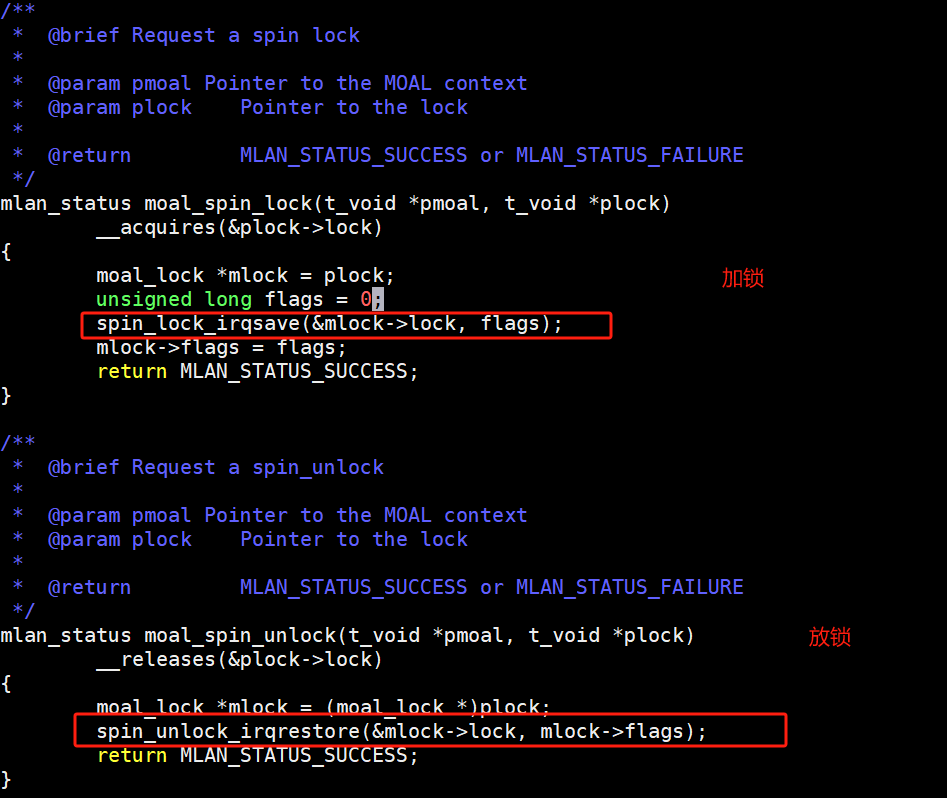
spin_lock—— 不安全的 API(会发生死锁,不建议使用)spin_lock_irq—— 全局中断的关闭(会发生死锁)(禁止硬中断)spin_lock_irqsave—— 记录中断的关闭状态(为线程安全的方案)推荐
四、内核使用案例
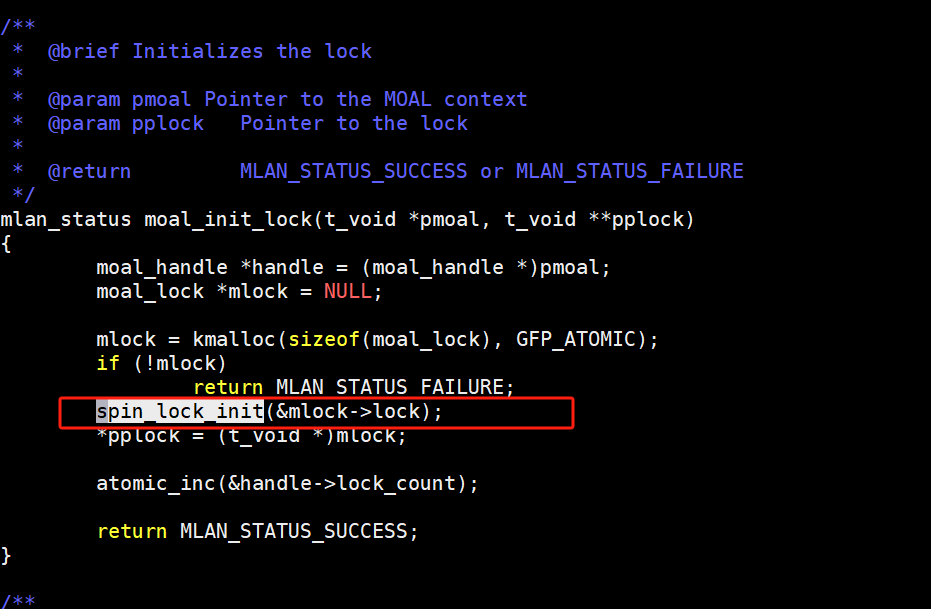
自旋锁的使用步骤
- 在访问临界资源的时候先申请自旋锁
- 获取到自旋锁之后就进入临界区,获取不到自旋锁就"原地等待"
- 退出临界区的时候要释放自旋锁
五、实现
忙等待(while(1))—— 不会让出 CPU 的资源。
c
static inline void arch_spin_lock(arch_spinlock_t *lock)
{
    unsigned long tmp;
    u32 newval;
    arch_spinlock_t lockval;

    prefetchw(&lock->slock);
    __asm__ __volatile__(
"1:     ldrex   %0, [%3]\n"
"       add     %1, %0, %4\n"
"       strex   %2, %1, [%3]\n"
"       teq     %2, #0\n"
"       bne     1b"
    : "=&r" (lockval), "=&r" (newval), "=&r" (tmp)
    : "r" (&lock->slock), "I" (1 << TICKET_SHIFT)
    : "cc");

    while (lockval.tickets.next != lockval.tickets.owner) {
        wfe();
        lockval.tickets.owner = READ_ONCE(lock->tickets.owner);
    }

    smp_mb();
}六、实验
源代码下载
bash
git clone git@gitee.com:yangxuesong314/linux-driver.git- 若之前已 git 拉取代码可以忽略
- 代码位于:
linux-driver/03.内核互斥锁技术/02.经典自旋锁的使用
驱动代码:
c
#include <linux/init.h>
#include <linux/module.h>
#include <linux/fs.h>
#include <linux/cdev.h>
#include <linux/kdev_t.h>
#include <linux/delay.h>
#include <linux/uaccess.h>
#include <linux/spinlock.h>

static spinlock_t spinlock_test;
static int flag = 1;     // flag = 1 表示设备没有被打开,等于 0 则证明设备已经被打开

static int open_test(struct inode *inode, struct file *file)
{
    spin_lock(&spinlock_test);     // 自旋锁加锁
    if (flag != 1) {
        spin_unlock(&spinlock_test);
        return -EBUSY;
    }
    flag = 0;
    spin_unlock(&spinlock_test);   // 自旋锁解锁
    return 0;
}

static ssize_t read_test(struct file *file, char __user *ubuf, size_t len, loff_t *off)
{
    int ret;
    char kbuf[10] = "linux";
	printk("\nthis is read_test \n");
    ret = copy_to_user(ubuf, kbuf, strlen(kbuf));
    if (ret != 0) {
		printk("copy_to_user is error \n");
    }
	printk("copy_to_user is ok \n");
    return 0;
}

static char kbuf[10] = {0};

static ssize_t write_test(struct file *file, const char __user *ubuf, size_t len, loff_t *off)
{
    int ret;
    ret = copy_from_user(kbuf, ubuf, len);
    if (ret != 0) {
		printk("copy_from_user is error\n");
    }
    if (strcmp(kbuf, "linux") == 0) {
        ssleep(4);
    } else if (strcmp(kbuf, "kernel") == 0) {
        ssleep(2);
    }
	printk("copy_from_user buf is %s \n",kbuf);
    return 0;
}

static int release_test(struct inode *inode, struct file *file)
{
	printk("\nthis is release_test \n");
    spin_lock(&spinlock_test);
    flag = 1;
    spin_unlock(&spinlock_test);
    return 0;
}

struct chrdev_test {
    dev_t           dev_num;
    int             major, minor;
    struct cdev     cdev_test;
    struct class   *class_test;
};

struct chrdev_test dev1;

struct file_operations fops_test = {
    .owner   = THIS_MODULE,
    .open    = open_test,
    .read    = read_test,
    .write   = write_test,
    .release = release_test,
};

static int __init atomic_init(void)
{
    spin_lock_init(&spinlock_test);
    if (alloc_chrdev_region(&dev1.dev_num, 0, 1, "chrdev_name") < 0) {
		printk("alloc_chrdev_region is error \n");
    }
	printk("alloc_chrdev_region is ok \n");
    dev1.major = MAJOR(dev1.dev_num);
    dev1.minor = MINOR(dev1.dev_num);
	printk("major is %d,minor is %d\n",dev1.major,dev1.minor);
    cdev_init(&dev1.cdev_test, &fops_test);
    dev1.cdev_test.owner = THIS_MODULE;
    cdev_add(&dev1.cdev_test, dev1.dev_num, 1);
    dev1.class_test = class_create(THIS_MODULE, "class_test");
    device_create(dev1.class_test, 0, dev1.dev_num, 0, "device_test");
    return 0;
}

static void __exit atomic_exit(void)
{
    device_destroy(dev1.class_test, dev1.dev_num);
    class_destroy(dev1.class_test);
    cdev_del(&dev1.cdev_test);
    unregister_chrdev_region(dev1.dev_num, 1);
	printk("module exit \n");
}

module_init(atomic_init);
module_exit(atomic_exit);
MODULE_LICENSE("GPL");驱动加载 insmod spinlock.ko:

应用测试代码:
c
#include <stdio.h>
#include <sys/types.h>
#include <sys/stat.h>
#include <fcntl.h>
#include <string.h>
#include <unistd.h>

int main(int argc, char *argv[])
{
    int fd;
    char str1[10] = {0};
    fd = open(argv[1], O_RDWR);
    if (fd < 0) {
		printf("file open failed \n");
        return -1;
    }
    if (strcmp(argv[2], "Linux") == 0) {
        write(fd, "Linux", 10);
    } else if (strcmp(argv[2], "kernel") == 0) {
        write(fd, "kernel", 10);
    }
    close(fd);
    return 0;
}