

主要包含
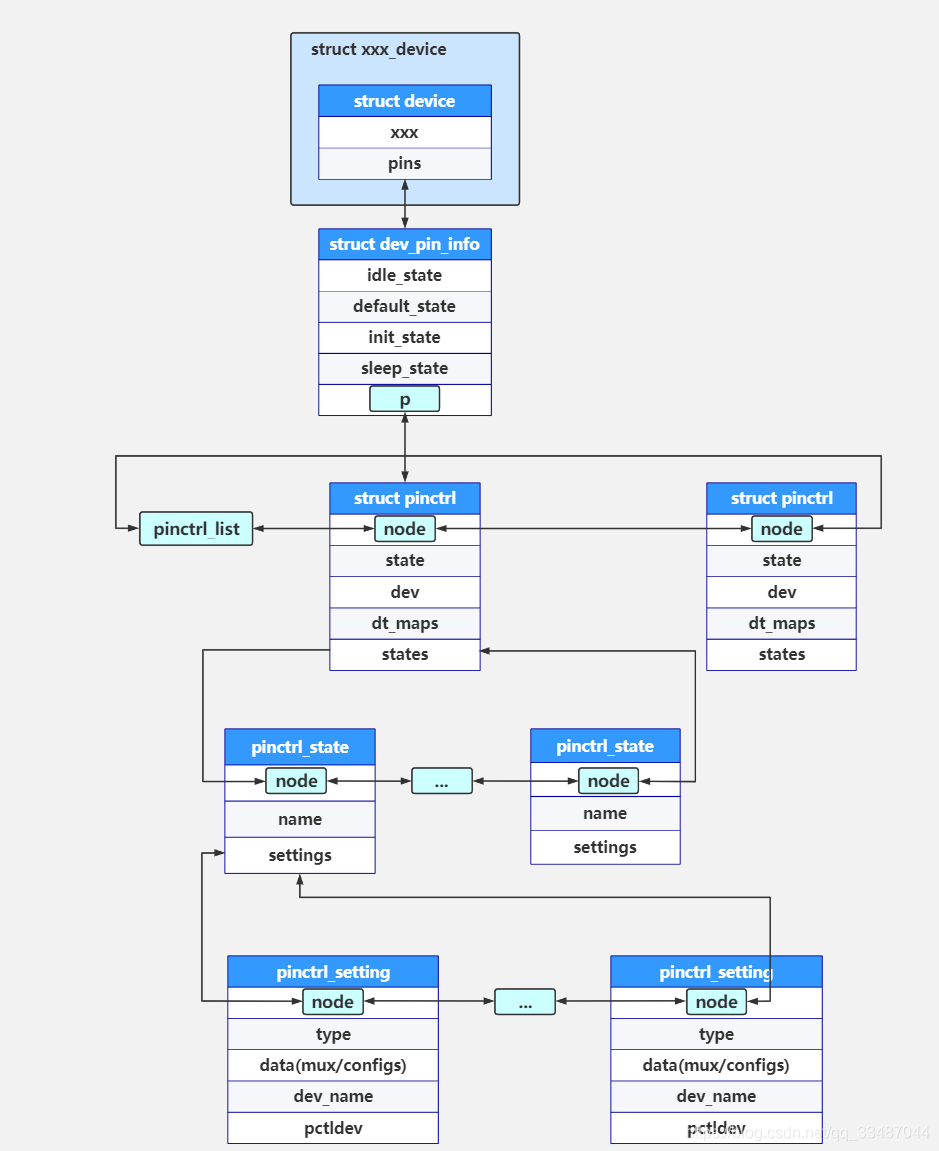
- struct dev_pin_info //各个驱动模块来填充
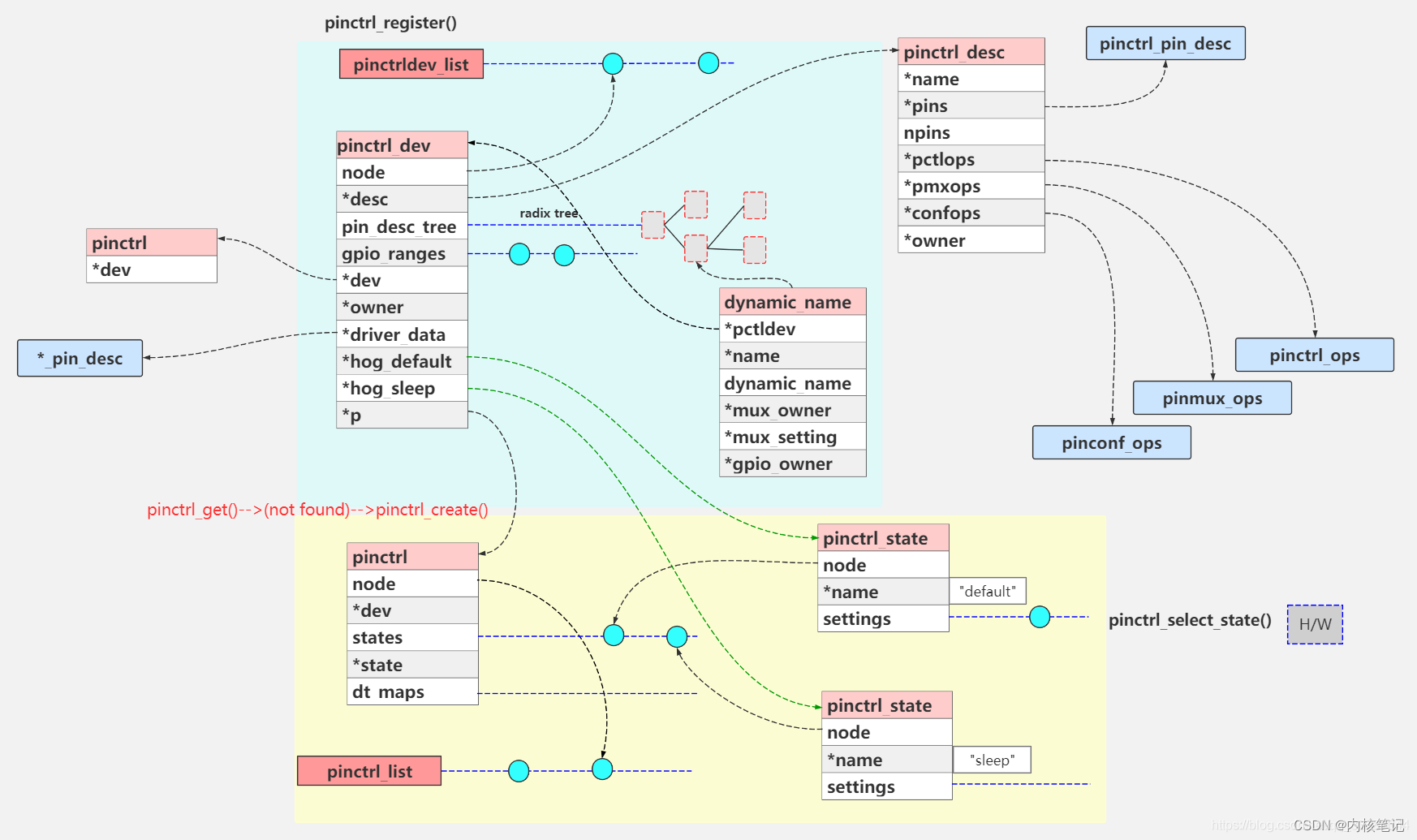
pinctrl_dev (给控制器使用)
struct pinctrl_desc //pinctrl 来填充(给控制器使用)
struct pinctrl //一个GPIO 复用的实例化(给客户端使用)
struct pinctrl_state //不同状态记录
struct pinctrl_setting //
一、dev_pin_info结构体
当系统启用 CONFIG_PINCTRL 配置时,设备结构体(struct device)会包含一个 struct dev_pin_info 来管理引脚信息。以下是这个结构体各成员的简要说明:
struct dev_pin_info {
    struct pinctrl *p;               // 引脚控制器指针
    struct pinctrl_state *default_state; // 默认状态
    struct pinctrl_state *init_state;    // 初始化状态
#ifdef CONFIG_PM
    struct pinctrl_state *sleep_state; // 睡眠状态(仅支持电源管理时可用)
    struct pinctrl_state *idle_state;  // 空闲状态(仅支持电源管理时可用)
#endif
};成员解释
**struct pinctrl *p**指向设备使用的 引脚控制器对象,用于控制和配置设备的引脚。**struct pinctrl_state *default_state**设备 正常工作时 的引脚配置状态(默认设置)。**struct pinctrl_state *init_state**设备 初始化阶段 使用的引脚配置状态。**struct pinctrl_state *sleep_state**设备 进入睡眠状态时 的引脚配置(仅当系统支持电源管理时可用)。**struct pinctrl_state *idle_state**设备 空闲时 的引脚配置(仅当系统支持电源管理时可用)。
::: 总结:
核心功能:管理设备在不同状态下的引脚配置(如默认、初始化、睡眠、空闲)。
依赖条件:
sleep_state 和 idle_state 仅在启用 CONFIG_PM(电源管理)时有效。
作用:通过不同状态的引脚配置,优化设备在不同场景下的性能和功耗。 :::
二、pinctrl_desc
pinctrl_desc 结构体定义在内核源码目录的“/include/linux/pinctrl/pinctrl.h” 文件中 :
struct pinctrl_desc {
    const char *name; // 引脚控制器的名称
    const struct pinctrl_pin_desc *pins; // 引脚描述符数组
    unsigned int npins; // 引脚描述符数组的大小
    const struct pinctrl_ops *pctlops; // 引脚控制操作函数指针
    const struct pinmux_ops *pmxops; // 引脚复用操作函数指针
    const struct pinconf_ops *confops; // 引脚配置操作函数指针
    struct module *owner; // 拥有该结构体的模块
    #ifdef CONFIG_GENERIC_PINCONF
    unsigned int num_custom_params; // 自定义参数数量
    const struct pinconf_generic_params *custom_params; // 自定义参数数组
    const struct pin_config_item *custom_conf_items; // 自定义配置项数组
    #endif
};pinctrl_desc结构体用于描述硬件中的引脚控制器信息,帮助软件管理芯片引脚的功能。以下是各部分的简单说明:
名称(name) 字符串名称,用来标识这个引脚控制器,比如"gpio-controller-1"
引脚信息数组(pins) 存储所有引脚的详细信息列表,每个条目包含:
引脚编号(如GPIO1_3)
对应的物理管脚功能(如USB数据线或LED控制)
引脚数量(npins) 上面数组里包含的引脚总数,告诉系统有多少个引脚需要管理
基础操作接口(pctlops) 这个函数指针集合包含:
引脚基本操作(如初始化/复位)
控制引脚开关状态
管理引脚组的通用功能
复用功能接口(pmxops) 管理引脚多路复用功能的函数集合,比如:
将某个引脚从普通GPIO切换为SPI总线使用
设置引脚的工作模式(输入/输出/中断等)
配置接口(confops) 处理引脚详细配置的函数,例如:
设置上拉/下拉电阻
调整驱动强度(信号强度)
配置引脚电平翻转等特性
模块归属(owner) 标记这个结构体属于哪个内核模块,防止不同模块间冲突
(当支持自定义配置时) 8. 自定义参数(custom_params) 存储厂商特定的特殊配置项,比如:
特殊的信号边沿检测模式
高级电源管理设置
::: 这个结构体就像芯片引脚的"使用说明书",把硬件能做什么、怎么操作都告诉操作系统,让软件可以安全地控制每个引脚的功能。 :::
三、pinctrl_dev
struct pinctrl_dev {
        struct list_head node;
        struct pinctrl_desc *desc;
        struct radix_tree_root pin_desc_tree;
#ifdef CONFIG_GENERIC_PINCTRL_GROUPS
        struct radix_tree_root pin_group_tree;
        unsigned int num_groups;
#endif
#ifdef CONFIG_GENERIC_PINMUX_FUNCTIONS
        struct radix_tree_root pin_function_tree;
        unsigned int num_functions;
#endif
        struct list_head gpio_ranges;
        struct device *dev;
        struct module *owner;
        void *driver_data;
        struct pinctrl *p;
        struct pinctrl_state *hog_default;
        struct pinctrl_state *hog_sleep;
        struct mutex mutex;
#ifdef CONFIG_DEBUG_FS
        struct dentry *device_root;
#endif
};四、pinctrl
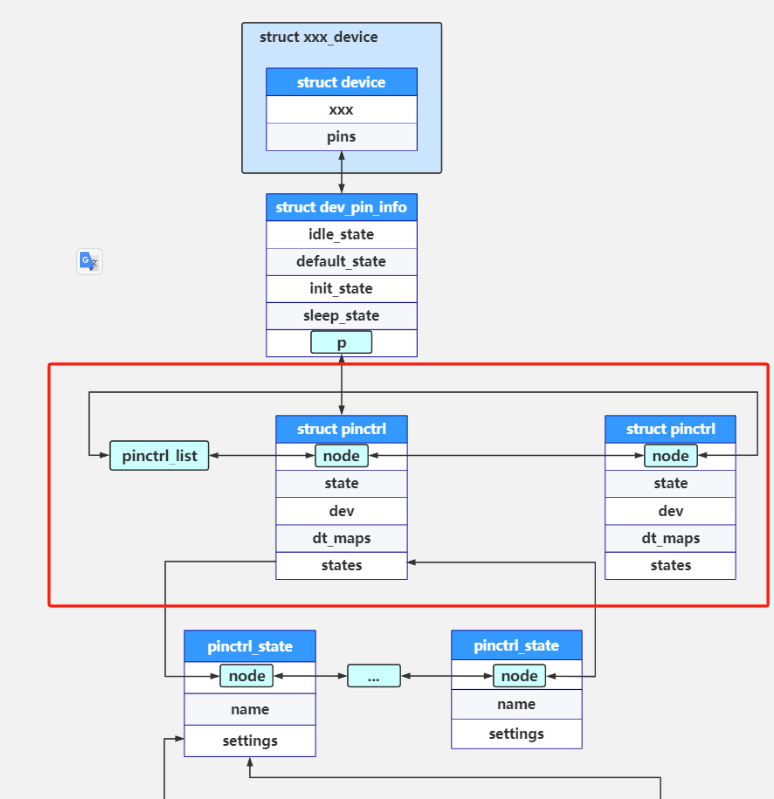
core.h
/**
 * struct pinctrl - per-device pin control state holder
 * @node: global list node
 * @dev: the device using this pin control handle
 * @states: a list of states for this device
 * @state: the current state
 * @dt_maps: the mapping table chunks dynamically parsed from device tree for
 *      this device, if any
 * @users: reference count
 */
struct pinctrl {
        struct list_head node;
        struct device *dev;
        struct list_head states;
        struct pinctrl_state *state;
        struct list_head dt_maps;
        struct kref users;
};五、pinctrl_state
/**
 * struct pinctrl_state - a pinctrl state for a device
 * @node: list node for struct pinctrl's @states field
 * @name: the name of this state
 * @settings: a list of settings for this state
 */
struct pinctrl_state {
        struct list_head node;
        const char *name; // default、sleep、自定义
        struct list_head settings;
};六、pinctrl_setting
struct pinctrl_dev *pctldev; 会在probe中填充
/**
 * struct pinctrl_setting_mux - setting data for MAP_TYPE_MUX_GROUP
 * @group: the group selector to program
 * @func: the function selector to program
 */
struct pinctrl_setting_mux {
        unsigned group;
        unsigned func;
};

/**
 * struct pinctrl_setting_configs - setting data for MAP_TYPE_CONFIGS_*
 * @group_or_pin: the group selector or pin ID to program
 * @configs: a pointer to an array of config parameters/values to program into
 *      hardware. Each individual pin controller defines the format and meaning
 *      of config parameters.
 * @num_configs: the number of entries in array @configs
 */
struct pinctrl_setting_configs {
        unsigned group_or_pin;
        unsigned long *configs;
        unsigned num_configs;
};


/**
 * struct pinctrl_setting - an individual mux or config setting
 * @node: list node for struct pinctrl_settings's @settings field
 * @type: the type of setting
 * @pctldev: pin control device handling to be programmed. Not used for
 *   PIN_MAP_TYPE_DUMMY_STATE.
 * @dev_name: the name of the device using this state
 * @data: Data specific to the setting type
 */
struct pinctrl_setting {
        struct list_head node;
        enum pinctrl_map_type type;
        struct pinctrl_dev *pctldev;
        const char *dev_name;
        union {
                struct pinctrl_setting_mux mux;
                struct pinctrl_setting_configs configs;
        } data;
};